PFAS, the “forever chemicals,” are in the tap water of millions of Americans. In 2024 the EPA set the first-ever federal limits on six of them. In 2026 the agency started walking those limits back. Here’s what changed, what it means for your household, and what you can actually do about it.
What are PFAS, in plain English?
PFAS (per- and polyfluoroalkyl substances) are a family of thousands of synthetic chemicals used since the 1940s in nonstick cookware, waterproof clothing, food packaging, and firefighting foam. They’re called “forever chemicals” because they barely break down, in the environment or in the human body.
Drinking water is one of the main ways people are exposed. EPA test data released in March 2026 shows that about 176 million Americans drink tap water containing PFAS, according to the Environmental Working Group.
The verified timeline: what happened
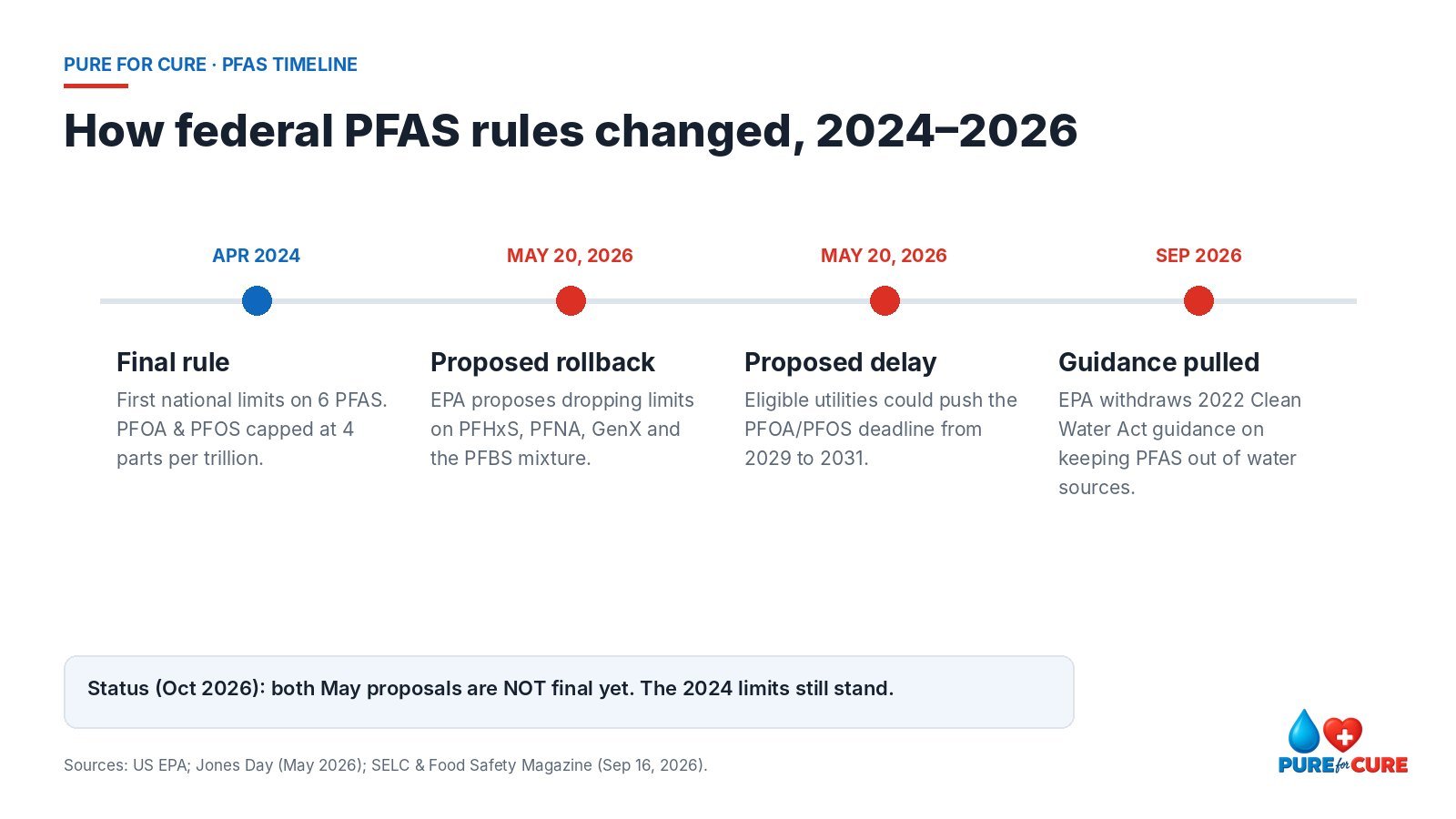
The rules are genuinely in flux, so the order of events matters:
- April 2024: The EPA finalized the first national drinking-water standards for six PFAS. PFOA and PFOS are each limited to 4 parts per trillion. PFHxS, PFNA, and GenX (HFPO-DA) got their own limits, and a mixture that includes PFBS is regulated through a “hazard index.”
- May 20, 2026: The EPA proposed rescinding the limits for PFHxS, PFNA, GenX, and the PFBS mixture. In a second proposal, it would let eligible water systems push their PFOA/PFOS compliance deadline back two years, from April 2029 to April 2031. Public comments closed July 20, 2026.
- September 2026: The EPA withdrew its 2022 Clean Water Act guidance that encouraged states and utilities to keep PFAS out of rivers and drinking-water sources in the first place.
- September 18, 2026: A federal appeals court (the D.C. Circuit) heard arguments in the water utilities’ challenge to the 2024 rule. Earlier in 2026 the court refused the EPA’s request to quickly throw out the four limits it now wants to drop. A decision is still pending.
Where things stand (mid-November 2026): both May proposals are still proposals. The EPA had aimed to finalize the rescission by September, but as of early November neither rule is final, and the 2024 limits remain on the books while the court case plays out. But the direction is clear: federal PFAS enforcement is loosening, not tightening.
What this means for your family
1. Your utility may get more time. If the delay is finalized, eligible utilities with PFOA/PFOS problems could have until 2031 to fix them. And four other PFAS could lose their federal limits entirely.
2. State rules matter more now. Some states, including New Jersey and Michigan, set their own PFAS standards that are stricter than the federal ones. Check whether yours has.
3. More of the burden falls on households. You don’t have to wait on a utility’s multi-year upgrade. Filtration at home works today.
4. “Meets federal standards” tells you less than it used to. Look at your utility’s actual PFAS test results (in its Consumer Confidence Report or the EWG Tap Water Database), not just its compliance status.
Filtration options that reduce PFAS
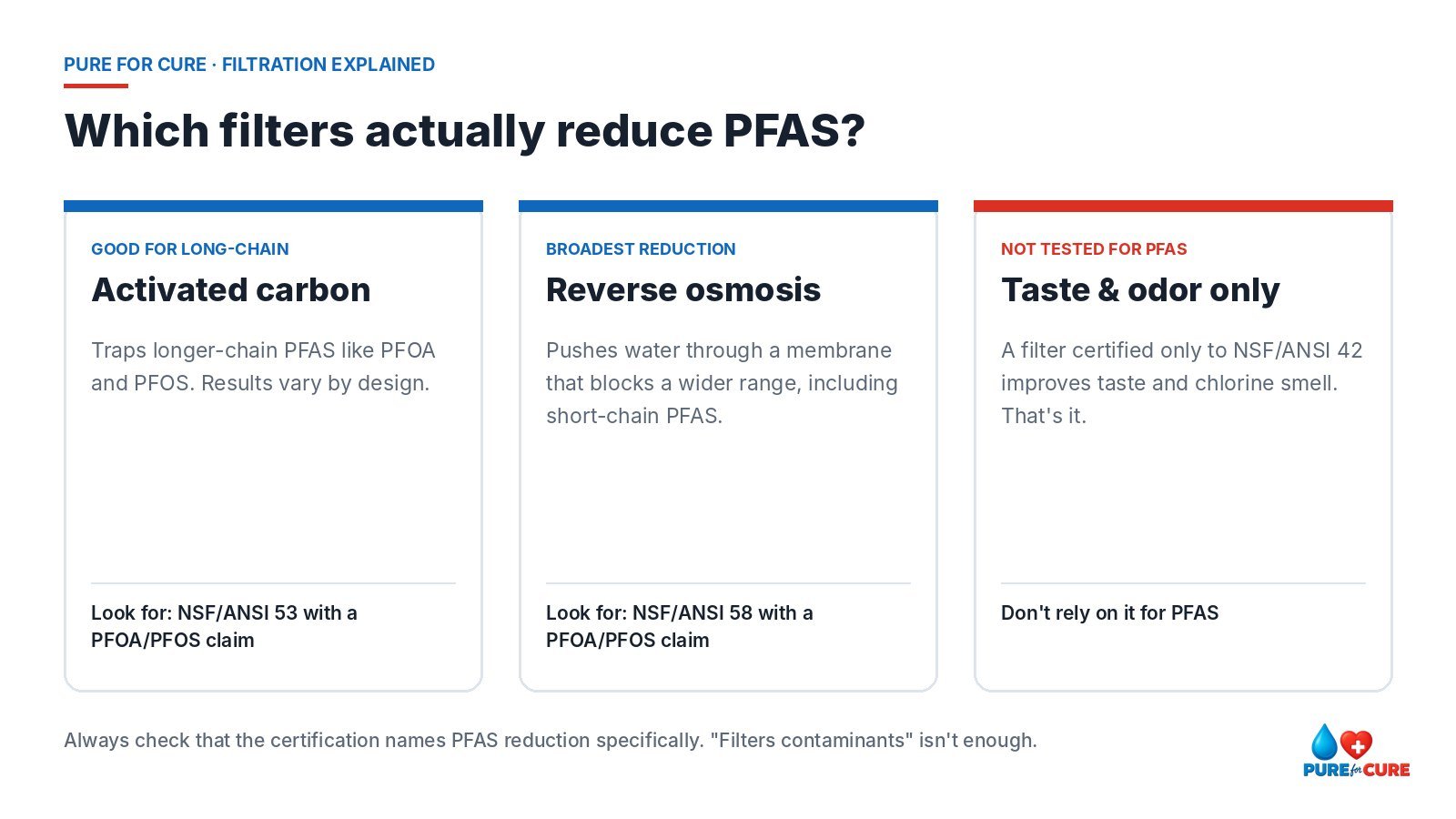
Not every filter handles PFAS. Two technologies have documented results:
- Activated carbon (granular or block): Good at capturing longer-chain PFAS like PFOA and PFOS. Performance varies by design. Look for certification to NSF/ANSI 53 with a specific PFOA/PFOS reduction claim.
- Reverse osmosis: Effective across a broader range of PFAS, including the shorter-chain ones carbon catches less reliably. Look for NSF/ANSI 58 with a PFOA/PFOS reduction claim.
Whatever you consider, check that the independent certification names PFAS reduction specifically. A filter certified only to NSF/ANSI 42 (taste and odor) hasn’t been tested for PFAS. For the bigger picture on what else shows up in household water, see What’s Really in Your Tap Water and our whole-home water systems.
What to do this week
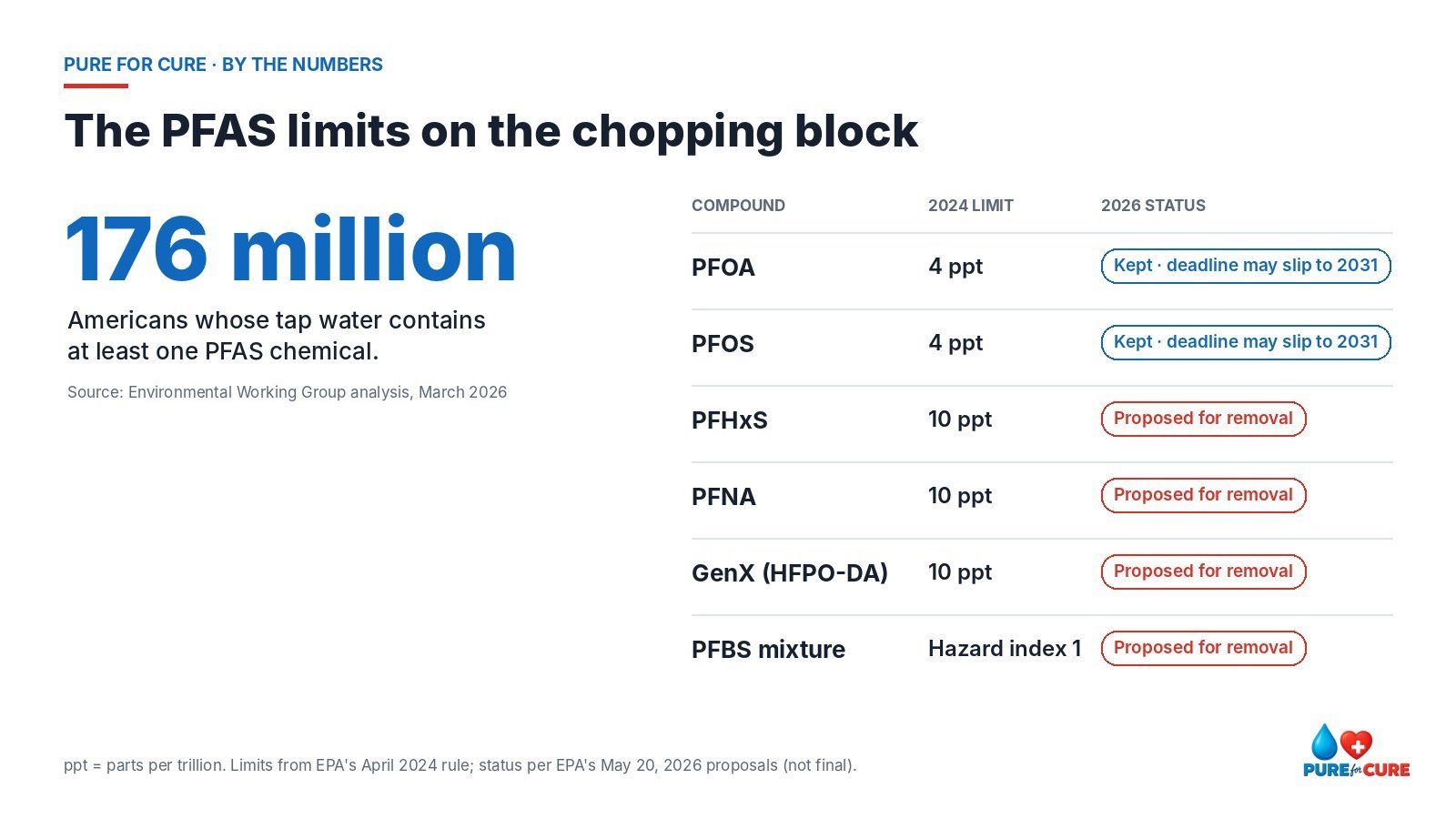
- Look up your zip code in the EWG Tap Water Database and check for PFAS detections.
- Read your utility’s Consumer Confidence Report for actual PFAS test results.
- Check whether your state has its own PFAS drinking-water standards.
- If PFAS shows up, get your own taps tested and look into certified filtration.
Free in-home water test
Concerned about PFAS in your water? Pure for Cure offers a free in-home water test and an honest consultation about your options. No pressure, no upsell. Request your free water test →
Frequently asked questions
What is the EPA doing about PFAS in drinking water in 2026?
On May 20, 2026, the EPA proposed rescinding federal drinking-water limits for PFHxS, PFNA, GenX, and the PFBS mixture, and letting eligible water systems delay PFOA/PFOS compliance from 2029 to 2031. In September 2026 it withdrew 2022 guidance on keeping PFAS out of drinking-water sources. As of mid-November 2026 neither proposal is final, and a federal court challenge to the 2024 rule is still awaiting a decision.
Does my water filter remove PFAS?
It depends on the filter. Activated carbon and reverse osmosis systems can reduce PFAS, but only if they’re designed and tested for it. Look for independent certification (such as NSF/ANSI 53 or 58) that specifically names PFOA/PFOS reduction. A general “filters contaminants” claim isn’t enough.
Is PFAS in bottled water too?
PFAS has been detected in some bottled water brands. Bottled water is regulated by the FDA, not under the EPA’s tap-water standards, so don’t assume bottled means PFAS-free.
Should I be worried about PFAS?
PFAS exposure is widespread and the chemicals build up in the body over time. Rather than worry, take the practical steps: check your local water data, test your taps, and consider certified filtration if PFAS is present.
Sources
- U.S. EPA: PFAS National Primary Drinking Water Regulation
- Jones Day: EPA Proposes to Rescind Certain PFAS Drinking Water Standards (May 2026)
- Waste Dive: EPA to formally rescind certain PFAS drinking water regulations (May 2026)
- Southern Environmental Law Center: EPA quietly withdraws guidance that stops toxic PFAS pollution (Sep 2026)
- Food Safety Magazine: EPA Withdraws Guidance on Preventing PFAS from Entering Drinking Water Sources (Sep 2026)
- Federal Register: Proposed rescission of limits for PFHxS, PFNA, GenX and the PFBS mixture (May 20, 2026)
- Federal Register: Proposed PFOA/PFOS compliance deadline extension (May 20, 2026)
- Harvard Environmental & Energy Law Program: PFAS in Drinking Water tracker
- Water Online: New data shows 176M exposed to forever chemicals (Mar 2026)
- Environmental Working Group: Tap Water Database
- NSF: water filter certification
Ready for cleaner water and air?
Get your free water test and consultation — no cost, no obligation.